Autonomous personal mobility and mobility-on-demand
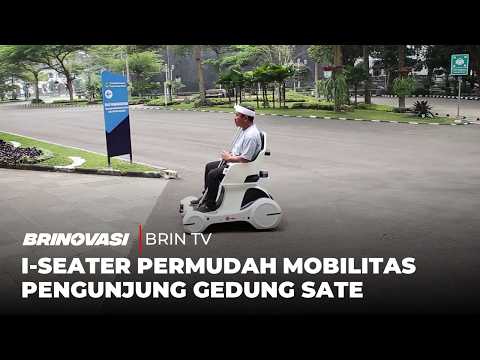
We develop SEATER (Single-passenger Electric Autonomous Transporter), a compact electric vehicle for first- and last-mile travel inside campuses, office complexes, and other managed areas, in indoor (I-SEATER) and outdoor (O-SEATER) variants. The aim is an autonomous mobility-on-demand service that is affordable enough to deploy in Indonesia.
The work covers the whole vehicle: platform design, docking and path tracking with nonlinear model predictive control, lane detection and lane keeping with learned perception, and a virtual-reality environment for driver testing. A new collaboration with Shanghai Jiao Tong University extends this towards semantic urban mapping and multimodal intelligent transport.
SEATER at the West Java Provincial Government complex, supporting the mobility of older people and people with disabilities.
Funding BRIN (2023, 2024), with Universitas Diponegoro; BRIN – LPDP – MOST China (2026), with Shanghai Jiao Tong University.
DELL-E is our last-mile delivery robot for delivery-on-demand in managed areas, developed as a complete system: the robot, its autonomy software, and the connected services around it. The work has produced a registered patent and an industrial design for the robot, and a companion delivery application.
DELL-E, an autonomous delivery robot for last-mile and last-metre delivery in restricted-access areas such as housing estates, apartments, offices, and government facilities (BRINovasi, BRIN).
In parallel, we study mobile robots for flexible manufacturing, including Mecanum-wheeled platforms and safe navigation with model predictive control and control barrier functions, and are extending this to multi-robot systems for smart manufacturing.
Funding BRIN (2025), with Universitas Diponegoro; BRIN (2026).
QUINS is a quadruped inspection system for industrial sites and high-risk zones, combining a legged platform with IoT connectivity and a multimodal sensor payload. Alongside the platform, we work on the perception a robot needs to understand such environments: semantic mapping, hazard mapping, and object detection with 360-degree cameras and 3D LiDAR.
Funding BRIN (2026), with Pertamina, Universitas Gadjah Mada, and Universitas Airlangga.
On the manipulation side, we work on position, force, and admittance control of a six-axis arm, and on vision-guided grasping. On the assistive side, we develop on-device tactile intelligence for low-cost prosthetic hands using bio-based stretchable sensors, and contribute to a lower-limb exoskeleton for physiotherapy assistance.
Funding Toray Science and Technology Research Grant (2025); BRIN – LPDP (2024), with Telkom University Surabaya.
A ground vehicle has to know where it is, reliably, and with sensors that are affordable. We fuse wheel odometry, inertial measurements, consumer-grade GPS, and visual mapping through extended Kalman filtering, and evaluate the result on personal mobility vehicles and mobile robots, indoors and outdoors.
Results include fusion-based localisation for outdoor personal mobility vehicles, a multi-sensor localisation system for low-cost indoor navigation, fusion of an indoor positioning system with odometry, and a survey of GPS-aided sensor fusion. My current work extends this line towards learning-based sensor fusion for state estimation.
Model predictive control (MPC) is a common thread across our robots. We use it to plan and track motion within the robot's dynamics and constraints: docking and path tracking for personal mobility vehicles with nonlinear MPC, and safe navigation for Mecanum-wheeled robots by combining MPC with discrete-time control barrier functions.
Current doctoral work extends this to adaptive MPC for mobile robots on potholed tracks and to MPC with control barrier functions for safe navigation. It builds on HiDO-MPC, which I developed during my PhD for autonomous casualty extraction.
My doctoral research at Imperial College London developed ResQbot, a mobile rescue robot that approaches and extracts casualties. Hierarchical decomposed-objective model predictive control (HiDO-MPC) coordinates the motion objectives of the approach, and ResQbot 2.0 adds a stretcher-style design with an inflatable neck-securing device. A review of rescue robots for casualty extraction followed in 2025.
Funding Indonesia Endowment Fund for Education (LPDP) doctoral scholarship.
Ground-projected point clouds provide a representation for detecting people lying on the ground. This work uses synthetic training data and augmentation to transfer a learned detector to real sensor observations.
At the Robot Intelligence Lab I also contributed to SLIDER, an ultra-lightweight knee-less bipedal walking robot, and to Robot DE NIRO, a mobile research platform for manipulation.